Day 3 February 18, 2024 Kathmandu
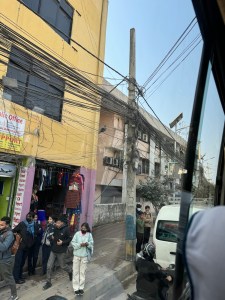
We are to meet in the lobby at 8:30 after eating breakfast to proceed to the orientation meeting. There we met our guide and the others in our tour. Twenty six of us all together. After a short break to gather travel stuff we loaded in a bus and headed for the sites. The city streets are narrow and run every which way. Most of the vehicles are local buses, scooters and motorcycles. They drive on the left side or the middle of the road. Sometimes the road is only one lane wide. Occasionally there is a traffic cop in the middle of a major intersection. I don’t remember seeing a traffic light. All kinds of businesses line both sides of the street. Living quarters are above. Power poles line both sides of the road with numerous power and telephone lines. Sometimes the lines go no where. Oh yes I forgot to mention that the city is built on small hills. So the roads go up and down and have sharp turns. People are everywhere. Men dress in western clothing while women wear a mixture of modern and Indian. Early in the day and late in the day traffic is quite light, but in the middle of the day it is very dense. We followed a river for a while. Not much water currently because this is the dry season. Lots of trash is in the river. After about 30 minutes we arrived at our first stop. The area is known as Bungamati. We stopped on the street and then slowly crossed the road. Now cross walks rarely exist and traffic still goes. Everyone just slowly walks across and the vehicles move around you in both directions.
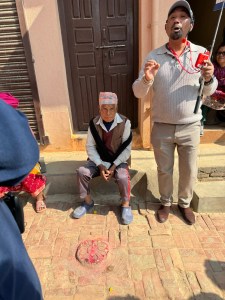
As we walk down the alley our guide points out things of interest. Some of them include markings in front of the door or on the sidewalk. He talks with residents and has them tell about themselves. One of those was an elderly gentleman who had a small gold earring. This was given to him by his family when he was 77 years 7 months 7 days and 7 hours old. (Now Rob needs an earring.) A second earring will be given if he makes 88. The alley is composed of uneven cement blocks so you need to be careful as you walk. We walked for 20-30 minutes to reach our first shrine. Nepal has experienced two major earthquakes. One in 1934 and one in 1972. They caused damage to buildings all over. Many of the shrines are under renovation so they are surrounded by scaffolding. Seeing them is not easy. Most are made of hardwood and are Hindu. Over 80% of the population is Hindu with the next largest group being Buddhist. The shrine is located in a small square surrounded by the city.
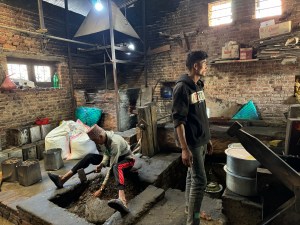
Back on the bus and off to the next stop Khokana. Here is where mustard oil is made. Mustard is a huge crop in Nepal. You can see it growing almost everywhere. Mustard oil has many uses including cooking and health care.

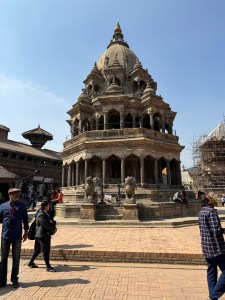
Next stop is the ancient city of Patan known for its fine arts. This location used to be a royal palace and has a much larger square. There are numerous shrines in varying sizes with a pagoda architecture. Temples to various Hindu gods and Buddha are scattered throughout the square. The crowds are much larger here. The group split up somewhat with those wishing to explore more and those wishing to have lunch. We chose lunch. We went to a cafe that supposedly did fast food. Well it didn’t seem very fast. We had a chicken burger and a grilled ham and cheese sandwich. Neither was like home. The French fries were much the same however. The restaurant is small and very crowded. We are back on the bus for a drive and short visit to a carpet factory. Having seen this numerous times we chose to remain on the bus. That night we had a welcome dinner in a restaurant a short distance from the hotel with the entire group. Surprisingly dinner included a glass of wine or beer if you wanted it.
 Spoffords Travel