Day 4 April 16, 2026 Yerevan Armenia
Today we ventured out a short distance from the city. As we drove out of the city you could see the still existing Soviet era buildings and then the new structures in the suburbs. The rental price for the new buildings is significantly higher plus you would have a longer commute. The Soviet buildings are in sad shape.
We stopped briefly for another photo opportunity of Mount Ararat. Today is even better than yesterday. The mountain is quite beautiful.
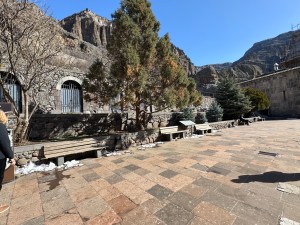
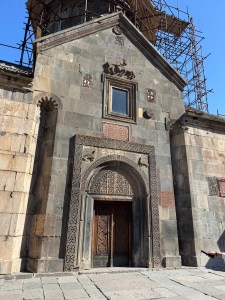
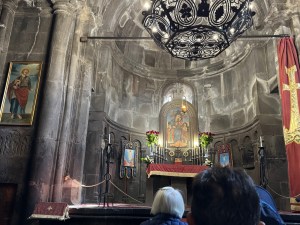
We are headed for UNESCO-listed Geghard Monastery, located about 40km (approx. 1 hour) east of the capital in the Azat Valley. Founded in the 4th century, the complex is renowned for its structures carved directly into the surrounding solid rock cliffs, featuring stunning ancient Armenian architecture. The site consists of a main church, a narthex, and two main cave churches entirely carved inside the mountain. Originally founded by Gregory the Illuminator in the 4th century, the present-day structures date back to the 12th-13th centuries. The name Geghard means lance or spear referring to the spear that allegedly wounded Jesus at the crucifixion which was housed here for centuries. At least two other spears exist. All were brought together for testing. The general consensus was that the one located in Armenia is the most likely to be authentic. The pillars and arch ways inside the church are amazing. In one of the rooms a natural spring comes out of the rock. Many believe it has healing powers. A choir of two men and two women sang for us inside one of the areas. The songs were from the 12th century. The acoustics made it sound like a large choir.
Along the walk up to the entrance are reproductions of some of the grave markers called cross stones here. They all had some form of a cross. The most popular being the Armenian blooming cross which is a intricately decorated cross symbolizing the Resurrection of Christ, eternal life, and faith. Unlike the crucifix, it signifies life-giving power rather than death, often featuring sprouted, leafy branches and intricate, floral patterns.
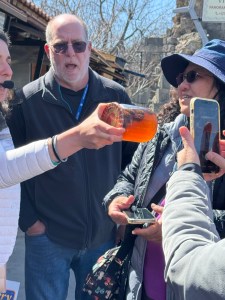
A few vendors are at the bottom when we returned. We were the first bus on the site which was really nice because we had the location to ourselves most of the time. The vendors were selling two common food items. One was fruit leathers of various flavors. The second was a traditional candy made by dipping walnut halves threaded on a string into a thick, spiced grape syrup. Often referred to as “Armenian Snickers,” this chewy treat is a staple on Armenian festive tables, particularly during New Year and Christmas. Even though this is a sweet, by our standards it isn’t very sweet. We all got to sample both.
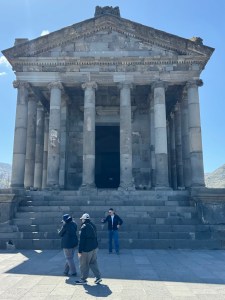
Then we were off to the Greco-Roman temple of Garni. This is the only in tact Pagan temple in the country. It sits in a beautiful park with cherry trees lining the walkway. The trees are in bloom so lots of pictures being taken. Below in the canyon a river is flowing. Everything in the area is green. It was built in the first century. An earthquake in 1679 destroyed it, but in the 1970’s it was restored. A Christian church was built next to it in medieval times which was completely destroyed by earthquake later. A palace had existed once but very little if anything remains. The Roman bath house is still basically intact. A mosaic is still visible but in bad shape. We were treated to a traditional flute concert by a local musician. The flute was played more like an oboe.
From here we walked to lunch. Unfortunately for us we missed one of the turns to the lunch site. We knew about where it was because of the location of the bus. Rob finally asked in what we thought was tourist information. They called around and found where we should have been. We missed the demonstration of bread making and about half of the meal time. Well at least we are back with the group. Similar salads and grilled trout.
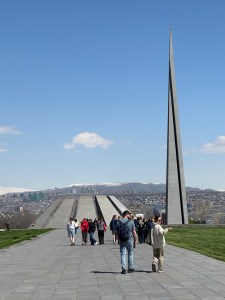
We returned to the city and visited the Genocide Museum. Neither of us had any idea this was going on. About 1.5 million Armenians were killed during the genocide. The genocide occurred around 1915. The complex consists of a circular structure with eternal flame inside, a tall column representing the rebirth of the country and the institute. The institute studies genocides wherever they have occurred. Many displays of the events involved the the Armenian genocide. Very sobering experience.
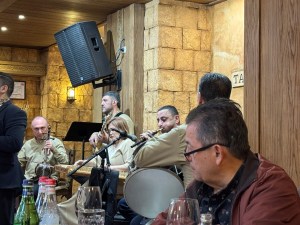
Later that evening we took the optional tour to dinner and a folk music and dance event. The band consisted of drum, guitar, local flute, the Kanin large, trapezoidal plucked string typically features 72 strings arranged in sets of three, laid across the lap with harp like sound and the kamancheh a small, bowed string instrument with a spike fiddle featuring a spherical, resonant body. The dancers were in costume. The dances are very energetic and the music was loud. Our beef stew turned out to be lamb but still good. A little girl about 2-3 loved dancing to the music.
 Spoffords Travel